
Site and content copyright © 2017 by Stylus Productions. All rights reserved.
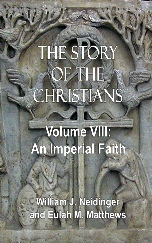
THE STORY OF THE CHRISTIANS
Volume VIII: An Imperial Faith
Diocletian’s establishment of the Tetrarchy was fundamental to these developments. Diocletian divided up the rule of the
Roman Empire in order to save it. The consequence was a legal precedent by which the Roman Empire could ultimately be divided and then dissolved. As the Tetrarchy was the division both of ruling power and the concomitant land mass of the Roman Empire, so Latinate Roman Catholic Christianity came to predominate in the western provinces of the Tetrarchy and Hellenic Greek Orthodox (and later Coptic, Armenian, and Syriac) Christianity dominated the eastern provinces. As went the political divisions, so went the religious divisions.
Exacerbating the political and religious divisions was Constantine’s selection of Constantinople as what would become the Roman Empire’s new capital city, which would require a bishop of commensurate status. And so there was established the rivalry between the Bishop of Rome (the Pope) and the Bishop of Constantinople (the Ecumenical Patriarch) that would endure for more than a millennium.
Constantine’s embrace of Christianity was more than just a personal conversion. It entailed bringing the Church into a new and singular partnership with the State. What needed to be defined were the parameters of that partnership. Was this to be a partnership of equals? Would the State dominate the Church, or vice versa? That the Emperor should represent the State was natural enough, but who was going to represent the Church, the Bishop of Rome, the Bishop of Constantinople, or a council of bishops? And who was to determine the composition and calling of a council? This would be one of the key conflicts that wracked western Europe and eastern Byzantium in late antiquity and throughout the Middle Ages and Renaissance.
Constantine’s embrace of Christianity in 312 laid the path for Christianity to become the official religion of the Roman Empire by 391, but along the way there would be a pagan revival and unending civil upheavals regarding which Christian sect could lay claim to espousing the official Christian creed. Christians would come to persecute Christians, leaving the last pagan emperor, Julian, to remark that there was no more ferocious an animal than a Christian attacking another Christian.
The new partnership of Church and State inaugurated by Constantine had a tremendous impact upon the demeanor of Christianity. Christianity no longer lurked in the shadows, but came out into full daylight. To profess the faith was no longer a social impediment; in fact, it fast became an expedient to social advancement. Christianity became an imperial faith. And as the faith and face of the Roman Empire, Christianity acquired a new look, one of majesty. This is perfectly reflected in the art and architecture of the era.
Chapters in VOLUME VIII:
1. Introduction
2. St. John in Lateran
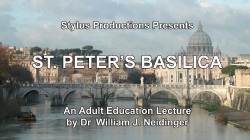
3. St. Peter in Vaticano
4. The Christian Funerary Structures of Rome
5. Jesus’ Tomb and the Church of the Holy Sepulchre
6. Constantine, Constantinople, and Christianity
7. The Enigmatic Helen and her Relics
8. The House of Constantine: Purges, Fratricides, Assassinations and Civil Wars
9. The House of Constantine: Religious Tumult and Turmoil
10.The Birth of Christian Art
11.Medieval Stories of Constantine
It is hard to overstate the impact which Constantine had on the course of European history and, in particular, on the development of Christianity. In this volume our task will be to establish the trajectory upon which Constantine set the Christian religion and the Roman Empire.
Now available at Amazon.com
Related Video Series



 Printed Book
 E-Book