
Site and content copyright © 2017 by Stylus Productions. All rights reserved.
THE STORY OF THE CHRISTIANS
Volume XIII: Rome After Charlemagne
Although Rome itself was growing shabbier, certain developments ensured a steady stream of visitors to the city – ecclesiastics, refugees, and especially the pilgrimage and tourist traffic. The major Christian sites, the great basilicas and the catacombs, sprouted attendant structures: monasteries, convents, libraries, hostels, inns, baptistries, diaconiae (to care for the poor) and small baths and hospices.
In this volume we examine the mosaic and fresco decoration of four early Medieval churches in the city of Rome, whose artistic techniques and iconography straddle the ancient Roman and Medieval worlds. We will trace the evolution and adaptation of ten ceremonies and symbols that would find their way into Medieval Christian liturgy and art. We will describe how Christians of the Middle Ages began again to scour the Old Testament, not so much for newly discovered Messianic prophecies but for “types” or “prototypes” or “foreshadowings” of Christ and the events of the New Testament. And we will explore the development of the cult of the saints and their relics.
The liturgy of the Christians continued to develop into the Middle Ages, and in this volume we review specifically the development of the liturgical service which would come to be called the Mass.
Throughout this volume we continue to describe the developments in Christianity in their political context, specifically touching upon the interactions between the heirs of Charlemagne and the Popes, along with the complications arising from the Lombards and the Arabs. The 9th and 10th centuries proved a low point in the institution of the Papacy, described by certain modern scholars as the “Pornocracy.” We survey how the Popes of this era met the political trials of the day, as well as the challenge presented by the continuing deterioration of the city of Rome.
Despite the aphorism “all roads lead to Rome,” by the 9th century Rome was no longer the strong and vibrant city it once was. Mostly abandoned by the rulers of the Roman Empire, the city of Rome had never recovered from the catastrophic damage done by the Byzantine - Ostrogothic Wars of the 6th century. While gates, walls, and aqueducts were repaired, ruined buildings were left as ruins and served as convenient quarries. But as the Eternal City slid slowly into dilapidation, there was one factor which arrested this advancing decrepitude – the Christian church.
Now available at Amazon.com
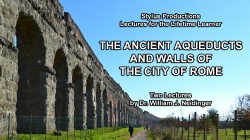
Related Videos

 Printed Book
 E-Book
Chapters in VOLUME XIII:
1. All Roads Lead to Rome
2. Four Churches in Rome
3. Ten Medieval Christian Ceremonies and Symbols
4. Re-Reading the Old Testament
5. The Saints and their Relics
6. The Development of the Roman Mass
7. The Nadir of the Papacy